VN Supply Chain
What can this site really make, and what stops it making more?
Capacity, downtime and transfer questions answered on the site model, from the exports your planner already has.
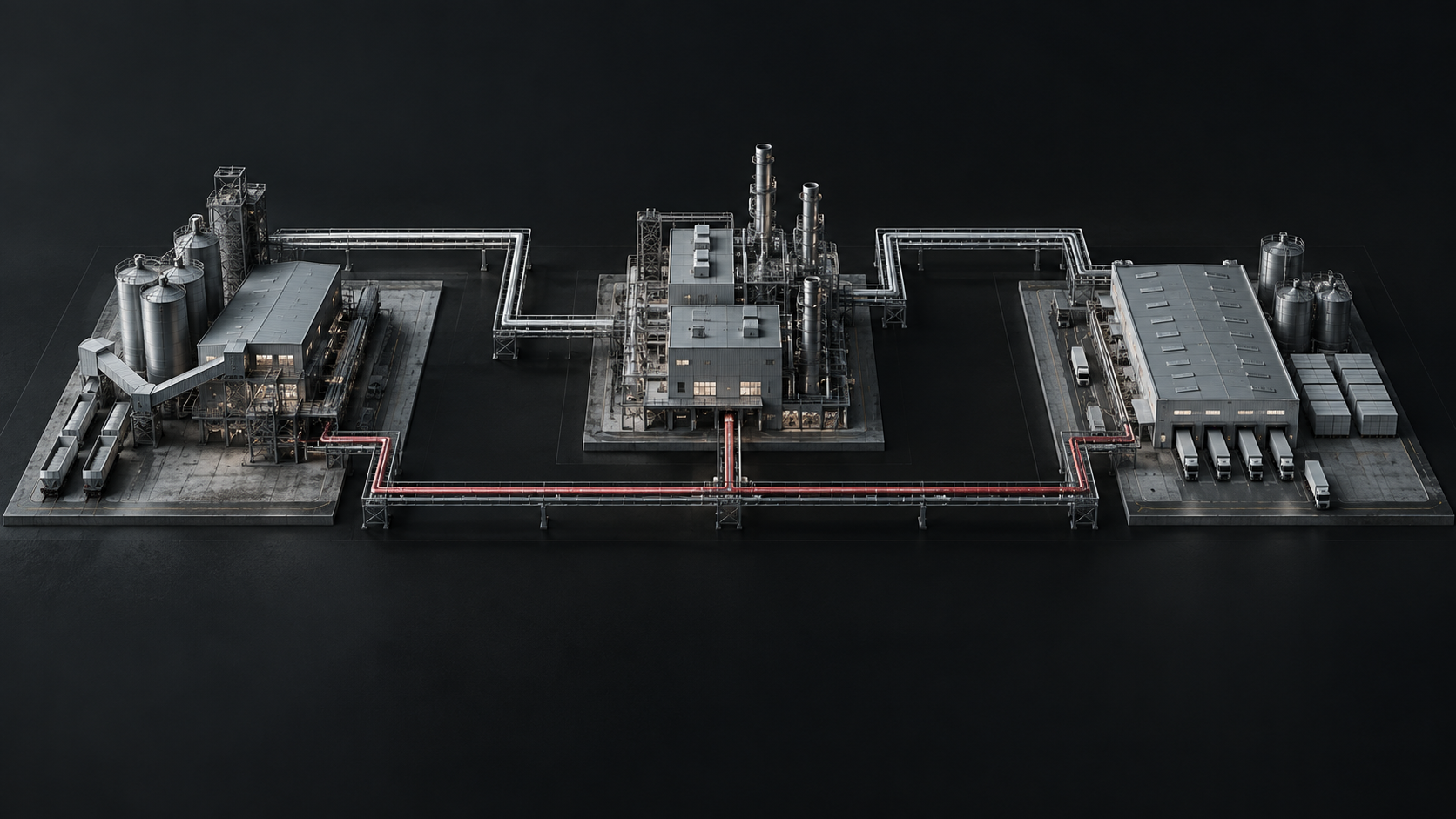
Your planner's files, placed against the site, validated fact by fact.
No connector is required, and none is built until the cadence demands it.
Planning exports, OEE and downtime logs, changeover matrices, shift schedules, bills of materials, capacity spreadsheets and transfer plans are read into SyntaGraph and placed against the model of the site. Your planner or engineer validates each extracted fact. The source, the date and the validator are recorded with it.
Updates arrive as weekly or monthly file drops. SyntaGraph compares them with the last validated state, and only what changed needs review. The planning tool stays where it is, and the model feeds it a capacity input with a source behind every number.
Declared
What the planner assumes and what the nameplate says.
Documented
What the exports and logs say, with a source and a date.
Demonstrated
Validated history against the modelled site, with a validator recorded. A capacity number is demonstrated only with both.
Six questions, on one model.
The first two are sold together to one budget holder. The rest follow as the site asks them, or once a second site is modelled.
Operations support
Operational baseline
What is actually true about how this site runs. A validated operational layer on the site model built from your own exports, with a weekly or monthly diff of what changed and a declared, documented or demonstrated status on every fact.
Everything else runs on this layer. Set-up is priced like a first study, followed by a modest cadence fee.
Operations support
Capacity truth-check
What this site or line can really do and what binds it. Declared against demonstrable capacity, with the binding constraint named: changeover footprint, utility headroom, space, access or shutdown need.
The check feeds planning and site decisions. It does not replace the planning tool or forecast demand.
Operations and risk
Downtime and disruption evaluation
What a stoppage, an outage or a shutdown costs in throughput, and what physically mitigates it. Scenarios run on the modelled site, with predictions committed before the event.
This needs the operational baseline in place. Demand forecasting, procurement and logistics execution are outside scope.
Front end
Expansion and de-bottlenecking options
Which growth options physically fit, and what each costs in utilities and shutdown time. This is the feasibility study pointed at a capacity question.
Delivered as feasibility scope on the same site model.
Network strategy
Network design inputs
Evidenced site constraints and transfer inputs for your network model, so the comparison between sites runs on demonstrated capacity.
This needs two or more modelled sites. Comparison across customers happens only with reciprocal permission.
Asset acquisition and development
Consolidation and site-selection evidence
Which sites can support the capability, capacity and transfer required, with condition and transfer cost evidenced. Due diligence across an owned network, or pointed at a contract manufacturer's claimed capacity.
The evidence is decision input. The site selection stays yours.
We make the planner's model true and stop there.
Demand forecasting, procurement and sourcing execution, logistics execution, operating or reselling the planning tool, and any live connector before a customer has asked for a cadence beyond monthly are outside what we do.
Operational data stays inside your boundary. Product, batch and process information never leaves it. A snapshot that feeds a quality decision must meet data-integrity expectations, which is a different bar, and the proposal says which bar applies.
Before the work starts.
Does this replace our planning system?
No. It makes the capacity model the planning system runs on true, and delivers it in the planner's format. The planning tool, the ERP and the quality system stay where they are.
Who validates the facts?
Your planner or engineer. SyntaGraph extracts and structures; a named person at the site confirms each fact, and their name and date are kept with it.
What if the evidence is not there?
The gap stays visible. A capacity number without a source and a validator is recorded as declared, and the deliverable says so. Where a question cannot be answered, the result is Not Demonstrated.
Do you need the site modelled first?
The operational baseline can be the first engagement on a site. The engineering studies and the supply chain questions run on the same model, so whichever comes first, the other starts warm.
Tell us the capacity question.
For planning, site operations, S&OP and network strategy leads with a question about what a site can actually do.